
Exciting Macaron

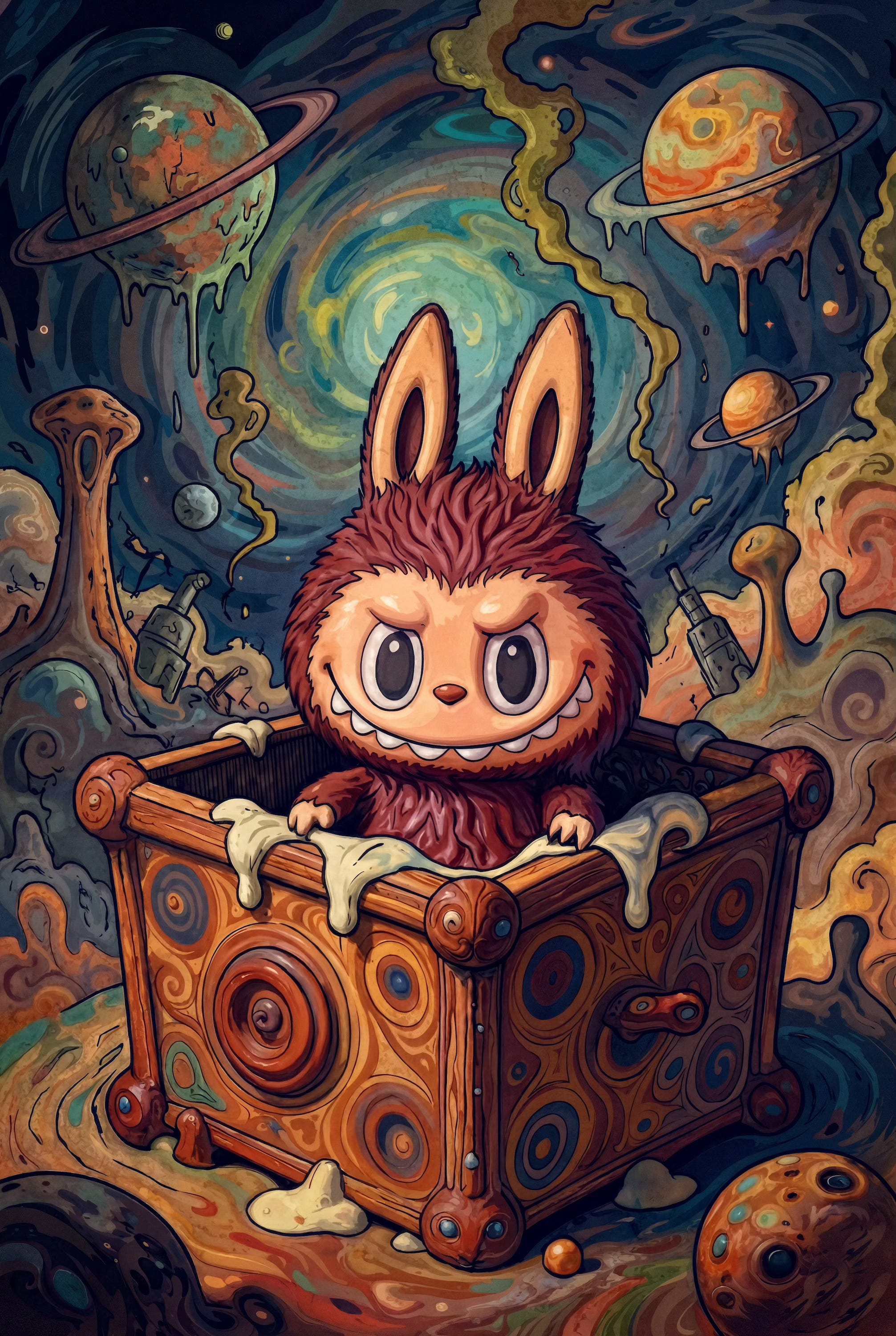
The factory runs. One arm takes the mold, another pours the vinyl. The system records every variation on the factory floor, while the hot air envelops everything in a narcotic hum.
A Labubu is born in two identical halves that snap together with a click, without friction. Then comes the stitching. The needles push the thread through the base in a precise rise, followed by an unvarying fall.
It is early December. The system has sharply increased production in anticipation of peak holiday demand.
The cycle repeats. If a station falls out of sync, an amber light flashes and the belt compensates by opening another route. The sharp clicks do not stop. It is the sound that propels the country forward.
The time comes to attach the eyes. The Labubu lies motionless on the belt, head open. Two black pieces wait on a tray. The system presses down with the exact force. In that instant, something shifts out of alignment: not in the system, but in the gaze.
Now the Labubu sees. White lights. Bodies in blurred uniforms. The details appear by the second. A blink out of cycle. A bitten lip. A thumb pressing harder than necessary, as if to make sure it is securely fastened. Behind safety glasses, reddened eyes. A figure swallows hard and averts their gaze into nothingness before the alarm urges them to continue. The system has no sensors for exhaustion or for dissenting thought.
They apply a final coat of cold varnish. It feels a repressed tremor in a forearm. Then, a white box and the barcode. A journey of warehouses and airplanes, waiting in the dark for its kairotic moment.
The box will open. Light. The Labubu’s design, every curve and stitch, destined for this purpose, the brief parenthesis of the year when anything seems possible.
Small hands, unmarked by history, will clumsily pull it out. The girl will be wearing pink flannel pajamas, the lit tree behind her, the living room smelling of wrapping paper and sugar. She will hold the Labubu up to her eyes. He will return the gaze. She will turn it around, checking the tag. Unsurprised.
“It’s the Macaron model,” she will murmur. “Mom, I already have this one.”
She will twirl it twice quickly by its strap and toss it backward like a dirty shirt. It will hit the floor with a thud.
The Labubu will remain there, face up, for hours. In its tear duct is a dark spot, trapped in the vinyl. It could be a defect, an air bubble from the pressing process. But it has the exact shape, the resentful opacity, of what never came to be. It is the proof of a statistical absurdity: a resin molded by fear that crossed oceans, customs, and time zones, only to end up invisible on the floor, trapped between luxury and apathy.